A smile can look uneven because of short or worn edges, mismatched shades, excessive gum display, gaps or tooth proportions that do not suit the face. Understanding how each feature is assessed helps you compare reshaping, bonding, whitening, veneers, crowns, gum treatment and orthodontics before choosing an irreversible step.
Key takeaways
- Choose reshaping only when limited enamel removal preserves tooth strength.
- Assess whitening against your existing fillings, crowns and natural tooth colour.
- Judge tooth proportion alongside gum display, lip movement and facial balance.
- Confirm every cosmetic change supports chewing, speech and long-term function.
Which treatments can change the shape of a tooth?
The right treatment depends on the defect, the healthy enamel available and the forces the tooth must withstand. Tooth reshaping is suitable only when a small change will solve the problem without weakening the tooth.
| Option | What it changes | When it applies and the trade-off |
|---|---|---|
| Enameloplasty | Removes a limited amount of enamel | A small sharp corner, minor asymmetry or slight excess length. Aggressive reduction can expose dentine, cause sensitivity and reduce future treatment options. |
| Composite bonding | Adds tooth-coloured resin | Repairs a chipped edge, closes a small gap, lengthens a short tooth or softens an uneven contour. It is conservative and repairable, but can stain, chip or lose its polish. |
| Porcelain veneers | Covers the visible front surface | Corrects colour, contour or several shape defects. They are not automatically no-preparation restorations; dark, protruded or crowded teeth may need space, preparation or orthodontics first. |
| Crowns | Covers the entire tooth | Suits teeth weakened by large fillings, cracks, extensive wear or root-canal treatment. A crown is excessive for a healthy tooth needing only a cosmetic change. |
Black triangles need their own diagnosis. A low contact point, tooth angulation or reduced interdental papilla can create the gap, so treatment may involve reshaping contacts, orthodontic movement, bonding or gum management. Complete closure is not always predictable.
How is tooth colour assessed and changed safely?
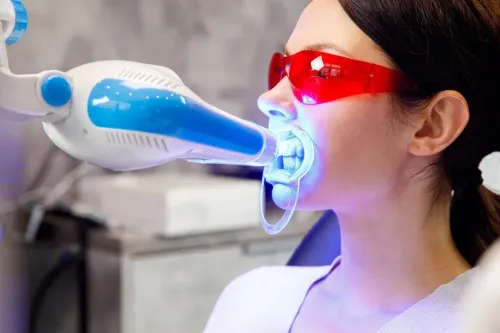
A tooth colour assessment is more than choosing one shade-tab value. The clinician evaluates brightness or value, hue, chroma, translucency, surface texture, and the surrounding gum and lip colours. Colour is selected with hydrated teeth in controlled lighting because dehydration makes enamel temporarily lighter and more opaque.
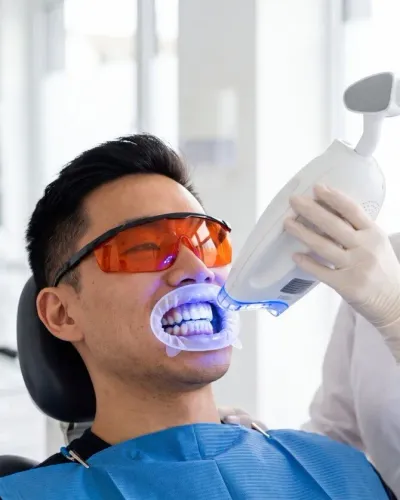
1. Plan teeth whitening before matching or replacing visible crowns, veneers, fillings, or bonding. Peroxide-based products lighten natural teeth, but existing restorations do not whiten in the same way. Matching a restoration first can leave it looking too dark after whitening.
2. Investigate internal discolouration separately from surface staining. A root-treated tooth may need internal whitening, performed within the tooth after the cause and the root seal have been assessed. Whitening does not replace treatment for decay, leaking fillings, exposed root surfaces, or active gum disease.
3. Choose masking or replacement when whitening cannot produce an even result. Composite masking covers localised dark areas or white and brown defects, but the resin must be blended for both opacity and translucency.
Ceramic restorations can hide deeper colour and reproduce layered optical effects; if surrounding teeth later change shade, they may require replacement or a new colour decision.
Sensitivity and soft-tissue irritation are recognised whitening effects. Peroxide concentration, contact time, frequency, and the condition of your teeth and gums affect risk. Treat gum disease or damaged teeth first, and do not judge a final shade while the teeth are dehydrated.
How are tooth proportion and smile features judged together?
Tooth proportion is judged across the visible smile, not by applying one fixed formula. The frequently quoted 0.618 golden proportion between successive visible tooth widths is not consistently present in natural smiles. Clinicians compare width and length with facial form, lip position, gingival display and your preference.
| Feature | What is assessed | Why it matters |
|---|---|---|
| Incisal edge | Position, level and relationship to the lower lip | Uneven edges can disrupt the smile arc and speech |
| Tooth relationships | Symmetry, midline, contact points and embrasures | Small differences can create gaps, black triangles or a crowded appearance |
| Lips and gums | Upper-tooth display at rest, lip movement during speech and smiling, and gingival display | Excessive gum exposure or hidden tooth structure can dominate the smile |
| Face | Facial symmetry and overall form | Teeth should support the face rather than appear isolated from it |
For upper central incisors, a visible width-to-length ratio of about 75–80% is a useful guide, not a rule. Increasing length can make a tooth appear narrower; increasing width or reducing length can make it look heavier or squarer.
Upper-tooth visibility tends to decrease with age while lower-incisor display increases. Lengthening an older adult’s teeth to imitate a youthful smile can therefore look unnatural. Uneven gum margins or excessive gingival display may require periodontal or orthodontic care before restorative work. The goal is balance between teeth, lips, gums and face, not mathematical uniformity.
What happens during a practical smile-design appointment?
A practical smile-design appointment starts by checking whether your mouth is healthy enough for cosmetic treatment, not by choosing a veneer shade. The clinician takes your medical and dental history, examines your teeth and gums, assesses your bite, and checks for decay, cracks, infection, worn teeth, leaking restorations and gum disease.
Treat these problems before definitive cosmetic work.
The starting smile is recorded before changes are planned:
| Record | What it shows | Why it matters |
|---|---|---|
| Photographs | Relaxed lips, full smile, profile views and close-ups | Captures tooth display and facial context |
| Digital dental scans | Tooth surfaces and the bite | Avoids relying only on impressions |
| Facial measurements | Dental midline and incisal edges relative to lips and face | Prevents an isolated tooth-based design |
| Diagnostic wax-up | Proposed tooth shapes on a model | Makes the intended contours inspectable |
| Smile mock-up | Temporary transfer of the proposal into your mouth | Tests speech, lip support, tooth display and cleaning access |
A computer preview supports communication, but it cannot guarantee final colour, translucency, texture, three-dimensional thickness or lip movement. The reversible smile mock-up often reveals a problem before tooth preparation begins.
At Achala Dental Clinic, ask which records will be taken, whether a reversible mock-up is suitable and which disease-control steps come first. Your written plan should specify:
- Treatment sequence and material
- Amount of tooth preparation
- Temporary phase and review points
- What happens if speech changes or cleaning becomes difficult
How does a smile plan protect function as well as appearance?
A functional smile plan tests proposed changes against speaking, chewing function and cleaning around restorations—not just a computer image. The clinician checks whether incisal edges interfere with the lower teeth, whether bite forces concentrate on a veneer or bonded edge, and whether altered tooth length changes “f” and “v” sounds.
| Check | What is assessed | Why it matters |
|---|---|---|
| Bite and movement | Jaw movement, tooth contacts, clenching and grinding | Prevents overload, chipping and premature wear |
| Space and position | Room for the planned material and the position of crowded teeth | Orthodontic movement may protect more enamel than cutting the tooth |
| Gumline and cleaning | Floss access, interdental-brush space and brushing access | A contour that traps plaque can cause inflammation and shorten restoration life |
Gum treatment or crown-lengthening may be needed when excess gum hides too much tooth or margins are uneven. Severe wear, cracks, infection or an unstable bite changes the order of care; stabilise these problems before placing final cosmetic restorations.
Ask these questions before accepting an irreversible plan:
- How much enamel will be removed, and what part is reversible?
- How will the shade be maintained and repairs managed?
- When will the restoration and gum health be reviewed?
Compare the proposed result with your natural tooth display, lip movement and face, not a computer image alone. A reversible mock-up can expose speech, lip-support or cleaning problems before preparation. The best design improves shape, colour and proportion without sacrificing tooth structure, comfort or cleanability.
Frequently asked questions
Which treatments can change the shape of a tooth?
Minor enamel reshaping can correct small irregularities. Composite bonding, porcelain veneers, crowns and orthodontic treatment address larger changes, with the choice depending on enamel, damage and bite forces.
How is tooth colour assessed and changed safely?
A dentist assesses natural tooth shade, stains, restorations and enamel condition before recommending professional whitening, stain removal or restorative treatment. Existing fillings, crowns and veneers do not whiten.
How are tooth proportion and smile features judged together?
The assessment considers tooth width and length alongside gum display, lip movement, midline, tooth position, facial proportions and the way teeth meet.
What happens during a practical smile-design appointment?
The appointment reviews your concerns, dental health, photographs, tooth colour, bite and treatment options. Your dentist then discusses a staged plan and the changes possible without compromising tooth structure.
How does a smile plan protect function as well as appearance?
The plan checks enamel preservation, bite contacts, chewing forces, speech, gum health and cleanability before cosmetic changes are selected.