Coffee, tea, tobacco, ageing and dental injury do not create the same type of discoloration, so one whitening method cannot solve every dark or yellow tooth. You will be able to identify the likely stain, compare treatment options, and know when an examination must come before any bleaching product.
Key takeaways
- Match whitening to the stain: peroxide treats many surface stains, not every colour change.
- Check for decay, gum irritation and existing restorations before bleaching.
- Professional whitening is faster; home trays offer gradual control at home.
- Expect temporary sensitivity and remember that fillings, crowns and veneers will not whiten.
Match the whitening method to the type of stain
Whitening works best on extrinsic stains because peroxide breaks down colour molecules on and near the enamel surface. Coffee stains on teeth, tea, red wine, tobacco and strongly coloured foods usually respond to bleaching, while toothpaste mainly polishes away limited surface deposits.
| Stain or colour change | Does whitening help? | Better match |
|---|---|---|
| Extrinsic stains from coffee, tea, tobacco and foods | Yes; usually the most predictable response | Professional bleaching, supervised trays or peroxide strips |
| Yellow teeth from ageing | Often; bleaching can lighten surface staining and yellowing within the tooth | Dentist-supervised bleaching, after checking enamel and dentin |
| Brown or grey intrinsic stains | Less predictably; the colour lies within dentin | Dental assessment, longer treatment or veneers |
| Fluorosis or tetracycline staining | Variable; banded or deep marks can remain visible | Targeted bleaching, bonding or veneers |
| One grey or dark tooth after trauma or root-canal treatment | External whitening may not correct the cause | Dentist-performed internal bleaching or another restorative treatment |
| Fillings, crowns and veneers | No; whitening does not change their manufactured colour | Replace or adjust the restoration after whitening, if needed |
A single dark tooth needs examination before bleaching because a damaged or non-vital pulp can be responsible. Internal bleaching requires endodontic assessment, a sealed tooth and follow-up; unsupervised treatment carries a risk of cervical root resorption. New extrinsic stains also return, especially with tobacco and frequent pigmented drinks.
Check whether your teeth and gums are ready for whitening
A dentist decides whether whitening is safe by checking your teeth, gums, existing dental work and the cause of each discoloured area. A dental examination before whitening can reveal problems that peroxide will not fix and could make painful.
The examination matters because cavities and teeth whitening do not mix: gel can reach decay through a broken surface and trigger sharp pain. Gum inflammation, cracked enamel, enamel defects, exposed roots and exposed dentin also increase the risk of sensitivity or chemical irritation.
A dentist will check:
- Cavities, leaking fillings and cracks that could let peroxide reach the inner tooth
- Gum inflammation, bleeding and recession that leave root surfaces unprotected
- Exposed dentin or worn enamel, which can make higher-strength or longer treatments uncomfortable
- Fillings, crowns, veneers, bridges and implant restorations, because whitening changes natural teeth but not these materials
- A single grey or unusually dark tooth, which could indicate pulp damage or a nonvital nerve rather than an ordinary stain
The dentist also judges whether the expected colour change is realistic. Whitening works on natural tooth structure, but it will not remove every intrinsic defect or correct a dead tooth; that tooth needs diagnosis first.
If you use trays, fit affects safety. A dentist-made tray keeps gel against the teeth and away from the gums more reliably than an overfilled or loose generic tray. Achala Dental Clinic can use this examination to identify treatment risks before recommending a whitening approach.
Compare professional, home and cosmetic whitening options
In-office teeth whitening gives the fastest visible change, but dentist-supervised take-home trays often provide the best balance of control, comfort and final shade. A well-fitted custom tray keeps gel against the teeth and away from the gums; overfilling it causes leakage and irritation, not proportionally better whitening.
| Option | Speed and control | Cost and expected colour change |
|---|---|---|
| In-office teeth whitening | Fastest visible result; treatment is controlled by the dental team | Higher cost; substantial change in natural teeth, but not necessarily a lighter final shade than well-used home trays |
| Dentist-supervised take-home trays | Slower, with treatment time and applications under your control | Mid-range cost; substantial change is possible when the tray fits and the gel is used as directed |
| Whitening strips | Convenient and less controlled; fit varies between brands and mouths | Lower cost; modest to noticeable change, with more risk of uneven contact or gum irritation |
| Whitening toothpaste | Slowest; mainly manages surface stains through mild abrasives and sometimes low peroxide | Lowest cost; limited colour change, and abrasive powders can wear exposed root surfaces |
| Cosmetic veneers | Immediate design control over visible tooth shape and shade, but requires irreversible tooth preparation | Highest treatment commitment; masks colour rather than bleaching natural enamel, and does not whiten existing restorations |
Choose trays if you want a gradual result you can monitor. Choose in-office treatment if speed matters for an upcoming event. Strips suit mild staining and a smaller budget, while toothpaste maintains cleanliness rather than replacing bleaching. Veneers make more sense when shape, defects or resistant discoloration—not just brightness—needs correction.
Know what happens during bleaching and how peroxide works
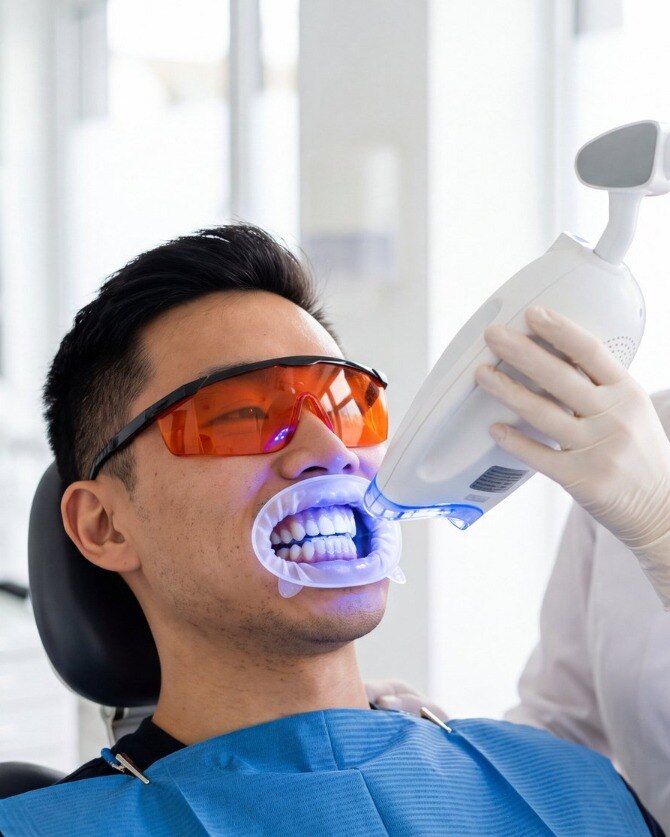
In-office whitening uses a relatively high-concentration hydrogen peroxide gel after the dentist protects your gums with gum isolation. The gel sits on the visible tooth surfaces for timed intervals, with rinse stages between applications; a light may be used if the system calls for it.
You leave with a faster visible change, not necessarily a lighter long-term shade than careful home treatment.
Carbamide peroxide is the main alternative. It breaks down into hydrogen peroxide and urea, so approximately 10% carbamide peroxide gives peroxide exposure broadly comparable to about 3% hydrogen peroxide, although contact time and the formulation affect the result.
Use dentist-supervised custom whitening trays this way:
- Place a small drop of gel in each tooth compartment; do not fill the tray.
- Seat the tray fully, then wipe away gel that squeezes onto your gums.
- Keep it in place only for the prescribed time. Longer wear increases irritation rather than delivering a proportional colour improvement.
- Remove the tray, rinse your mouth and the tray, and store the tray clean and dry.
- Stop and contact your dentist if burning, white patches or persistent soreness develops.
Sensitivity and temporary gum irritation are the common problems. Reduce the wearing time or pause treatment if sensitivity starts; higher concentrations, longer exposure and exposed dentin raise the risk. A poorly fitting tray leaks gel, while overfilling any tray pushes more peroxide onto gum tissue.
Plan for sensitivity, restoration colour and ongoing maintenance
Noticeable lightening often appears after a professional appointment. A dentist-supervised tray course develops over days to a few weeks, depending on the starting shade and the gel schedule.
Whitening is not permanent. Stain maintenance means limiting tobacco and frequently consumed pigmented drinks, keeping up daily brushing, and arranging occasional retreatment when the colour fades. Follow the product directions or your dentist’s schedule; repeated courses can worsen teeth whitening sensitivity and irritate your gums.
Sensitivity usually settles after treatment ends. If pain becomes sharp, lasts beyond the expected recovery period, or affects one tooth, stop whitening and arrange an examination rather than applying more gel.
Whitening crowns and fillings is not possible with peroxide. It changes natural enamel and dentin but leaves dental materials at their original shade, so a restoration can look darker or yellower after the surrounding teeth brighten.
- Fillings may need replacement after the new shade stabilises.
- Crowns, bridges and veneers may need shade matching or replacement if they show when you smile.
- Implant restorations keep their existing colour and may also become mismatched.
A single grey or brown tooth needs separate assessment. Whitening does not repair a damaged or dead pulp. Internal bleaching for a dark tooth can work better than external gel after appropriate root-canal and sealing checks, but cervical root resorption is a recognised complication, so follow-up is essential.
Frequently asked questions
Which stains respond best to teeth whitening?
Peroxide whitening works best on extrinsic stains from coffee, tea, red wine, tobacco and strongly coloured foods. It has less effect on intrinsic discolouration within the tooth.
Should you check your teeth and gums before whitening?
Yes. Have decay, cracked teeth, leaking fillings, gum inflammation and exposed root surfaces assessed before whitening because peroxide can worsen pain or irritation.
How do professional and home whitening options compare?
Professional whitening acts faster under dental supervision. Custom home trays provide gradual whitening, while over-the-counter strips and cosmetic products offer less control over fit, strength and coverage.
Why can teeth feel sensitive after bleaching?
Peroxide passes through enamel and dentine, temporarily irritating the tooth nerve. Sensitivity usually improves after treatment, but reduce exposure and seek dental advice if pain persists.
Will fillings, crowns and veneers whiten?
No. Dental restorations keep their existing colour, so whitening natural teeth can create a colour mismatch. Discuss replacement or colour planning with your dentist before bleaching.